1. Company, right - FACE. 2. Forward. 3. MARCH.
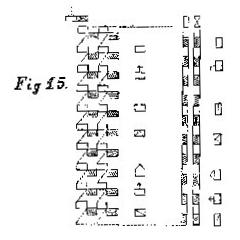
SCHOOL OF THE COMPANY.
MANNER OF FORMING THE COMPANY.
216. THE whole company being assembled on its parade ground, or in the rendezvous, the first, or orderly sergeant, will command:
At
this command the corporals and privates will form in one rank, faced to
the right, and in the order of height from right to left, the tallest man
on the right (now head of the company), the next tallest man immediately
covering the first, and so on to the left or rear of the rank, in which
position will be placed the shortest man. The other sergeants will
take post in the rank of file-closers, two paces the right of the company,
and assist the first sergeant in forming the company.
When
the men have their places, the first sergeant will command:
FRONT.
The second sergeant, who is the left guide of the company, will now place himself on the left of the company, and the orderly sergeant will promptly command:
1. In two ranks, form company. 2. Left - FACE. 3. MARCH.
At
the command left face, the whole company will
face to the left, except the guide and man on the left, who stand fast.
At
the command march, the whole of the men who have faced to
left, will step off together; the second man, counting from the left, will
place himself in the rear rank, behind the man next to the guide, and face
to the front; the two following men will, in like manner, on closing up,
form the next file, the third man in the front, and the fourth in the rear
rank behind him, and all the other men will come successively to form files,
two deep, to the right of those already formed.1
1.(When the company is in good discipline, the files may be formed in two ranks at once, each man having his proper number in the company depending upon his height, and being able to take his appropriate place without creating confusion.)
The
officers will now take their posts as prescribed in No. 8; if the captain
has to discharge the duties of instructor, the first lieutenant will take
his place on the right of the front rank, the second lieutenant replacing
the first behind the fourth section.
The
instructor will then cause the files to be numbered, and for this purpose
will command
In each rank - count TWOS.
At this command the men count in each rank from right to left, pronouncing in a loud and distinct voice, in the same tone, without hurry and without turning the head, one, two, according to the place each one occupies. He will also cause the company to be divided into platoons and sections, taking care that the first platoon is always composed of an even number of files.
To open ranks.
217. The company being at ordered arms, the ranks and file closers well aligned, when the instructor shall wish to cause the ranks to be opened, he will direct the left guide to place himself on the left of the front rank, which being executed, he will command:
1. Company. 2. Shoulder - ARMS. 3. To the rear, open order.
At
the last command, the covering sergeant (or orderly sergeant), and the
left guide, will step off smartly to the rear, four paces of twenty-eight
inches from the front rank, in order to mark the position for the rear
rank. They will judge this distance by the eye without counting the
steps.
The
instructor will place himself at the same time on the right flank, in order
to observe if these two non-commissioned officers are on a line parallel
to the front rank; and, if necessary, to correct their positions, which
being executed, he will command:
4. MARCH.
At this command the front rank will stand fast. The rear rank will step to the rear without counting the steps, and will place themselves on the alignment marked for this rank, each man stepping slightly behind the line, and then dressing forward as in the backward dress. The covering sergeant will dress the rear rank on the left guide placed to mark the left of this rank. The instructor seeing the rear rank aligned, will command:
5. FRONT.
At this command, the sergeant on the left of the rear rank will return to his place as a file-closer.
Alignments in open ranks.
218. The ranks being open, the instructor will, in the first exercises, align the ranks, man by man, the better to inculcate the principles. To effect this, he will cause two or four men on the right or left of each rank to march two or three paces forward, and, after having aligned them, command:
By file, right (or left) - DRESS.
At
this, the men of each rank will move up successively on the alignment,
each man being preceded by his neighbor in the same rank, towards the basis,
by two paces, and having correctly aligned himself, will cast his eyes
to the front.
219.
Successive alignments having habituated the soldier to dress correctly,
the instructor will cause the ranks to align themselves at once, forward
and backward, sometimes in a direction parallel, and sometimes in one oblique
to the original direction, giving, in each case, two or four men to serve
as a basis of alignment to each rank. To effect which, he will command:
1. Right (or left) - DRESS. 2. FRONT;
or,
1. Right (or left) backward - DRESS. 2. FRONT.
In
oblique alignments, in opened ranks, the men of the rear rank will not
seek to cover their file leaders, as the sole object of the exercise is
to teach them to align themselves correctly in their respective ranks,
in the different directions.
In
the several alignments, the captain will superintend the front rank, and
the covering sergeant the rear rank. For this purpose they will place
themselves on the side by which the ranks are dressed.
In
oblique alignments, the men will conform the line of their shoulders to
the new direction of their ranks, and will place themselves on the alignment
as has been prescribed in the school of the soldier, according as the new
direction shall be in front or rear of the original one.
To close ranks.
220. The instructor will command:
1. Close order. 2. MARCH.
At the command march, the rear rank will close up in quick time, each man directing himself on his file leader.
Alignments in closed ranks.
221.
The ranks being closed, the instructor will cause to be executed parallel
and oblique alignments by the right and left, forward and backward, observing
to place always two or four files as a basis of alignment. He will
give the same commands prescribed for opened ranks.
In
alignments in closed ranks, the captain will superintend the front rank,
and the covering sergeant the rear rank. They will habituate themselves
to judge the alignment by the lines of the eyes and shoulders, in casting
a glance of the eye along the front and rear of the ranks.
The
moment the captain perceives the greater number of the front rank aligned,
he will command FRONT, and rectify afterwards, if necessary, the
alignment of the other men by ordering this or thatfile
forwardor
back,
designating each by its number. The rear rank will conform to the
alignment of the front rank, superintended by the covering sergeant.
The ranks being steady,
the instructor will place himself on the flank to verify their alignment.
He will also see that each rear rank man covers accurately his file leader.
In
all alignments, the file-closers will preserve the distance of two paces
from the rear rank.
The
alignments being ended the instructor will exercise the company at the
manual, and finish with stacking arms as follows:
To Stack Arms.
222. The men being at order arms, the instructor will command:
Stack - ARMS.
At
this command, the front rank man of every even numbered file will pass
his piece before him, seizing it with the left hand above he middle band,
and place the butt behind and near the right foot of the man next on the
left, the barrel turned to the front. At the same time the front
rank man of every odd numbered file will pass his piece before him, seizing
it with the left hand below the middle band, and hand it to the man next
on the left; the latter will receive it with the right hand two inches
above the middle band, throw the butt about thirty-two inches to the front,
opposite to his right shoulder, incline the muzzle towards him, and lock
the shanks of he two bayonets; the lock of this second piece towards the
right, and its shank above that of the first piece. The rear rank
man of every even file will project his bayonet forward, and introduce
it (using both hands) between and under the shanks of the two other bayonets.
He will then abandon the piece to his file leader, who will receive it
with the right hand under the middle band, bring the butt to the front,
holding up his own piece and the stack with the left hand, and place the
butt of this third piece between the feet of the man next on the right,
the S plate to the rear. The stack thus formed, the rear rank man
of every odd file will pass his piece into his left hand, the barrel turned
to the front, and, sloping the bayonet forward, rest it on the stack.
223.
If the company be armed with rifles, or any piece without
the bayonet, arms will be stacked by the same commands, and in the following
manner: At the command stack arms, the front rank man
of every even numbered file will pass his piece before him, seizing it
with the left hand near the upper band; will place the butt a little in
advance of his left toe, the barrel turned towards the body, and draw the
rammer slightly from its place; the front rank man of every odd numbered
file will also draw the rammer slightly, and pass his piece to the man
next on his left, who will seize it with the right hand near the upper
band, and place the butt a little in advance of the right toe of the man
next on his right, the barrel turned to the front; he will then cross the
rammers of the two pieces, the rammer of the piece of the odd numbered
man being inside; the rear rank man of every even file will also draw his
rammer, lean his piece forward, the lock-plate downwards, advance the right
foot about six inches, and insert the rammer between the rammer and barrel
of the piece of his front rank man; with his left hand he will place the
butt of his piece on the ground, thirty-two inches in rear of, and perpendicular
to, the front rank, bringing back his right foot by the side of the left;
the front rank man of every even file will at the same time lean the stack
to the rear, quit it with his right hand, and force all the rammers down.
The stack being thus formed, the rear rank man of every odd file will pass
his piece into his left hand, the barrel to the front, and inclining it
forward, will rest it on the stack.
224.
The men of both ranks having taken the position of the soldier without
arms, the instructor will command:
1. Break ranks. 2. MARCH.
To Resume Arms.
Both ranks being re-formed in rear of their stacks, the instructor will command:
Take - ARMS.
At this command, the rear rank man of every odd numbered file will withdraw his piece from the stack; the front rank man of every even file will seize his own piece with the left hand, and that of the man on his right with his right hand, both above the lower band; the rear rank man of the even file will seize his piece with the right hand below the lower band; these two men will raise up the stock to loosen the rammers or bayonets; the front rank man of every odd file will facilitate the disengagement of the rammers, if necessary, by drawing them out slightly with the left hand, and will receive his piece from the hand of the man next on his left; the four men will retake the position of the soldier at order arms.
The firings.
To fire by company.
225. The instructor, wishing to cause the fire by company to be executed, will command:
1. Fire by company. 2. Commence firing.
At
the first command, the captain will promptly place himself opposite the
centre of his company, and four paces in rear of the line of file-closers:
the covering sergeant will retire to that line, and place himself opposite
to his interval. This rule is general, for both the captain
and covering sergeant, in all the different firings.
At
the second command, the captain will add:
1. Company. 2. READY. 3. AIM. 4. FIRE. 5. LOAD.
At
the command load the men will load their pieces, and then
take the position of ready, as prescribed in the school of the soldier.
The
captain will immediately recommence the firing, by the commands:
1. Company. 2. AIM. 3. FIRE. 4. LOAD.
The
firing will be thus continued until the signal to cease firing is sounded.
The
captain will sometimes cause aim to be taken to the right or left, simply
observing to pronounce right (or left) oblique,
before
the command aim.
The fire by file.
226. The instructor wishing to cause the fire by file to be executed, will command:
1. Fire by file. 2. Company. 8. READY. 4. Commence firing.
The
third and fourth commands will be executed as prescribed in the school
of the soldier.
The
fire will be commenced by the right file of the company; the next file
will take aim at the instant the first brings down pieces to reload, and
so on to the left; but this progression will only be observed in the first
discharge, after which each man will reload and fire without regulating
himself by others, conforming himself to what is prescribed in the school
of the soldier.
The fire by rank.
227. The instructor wishing the fire by rank to be executed, will command:
1. Fire by rank. 2. Company. 3. READY. 4. Rear rank - AIM. 5. FIRE. 6. LOAD.
The
fifth and sixth commands will be executed as is prescribed in the school
of the soldier.
When
the instructor sees one or two pieces in the rear rank at a ready, he will
command:
1. Front rank. 2. AIM. 3. FIRE. 4. LOAD.
The
firing will be continued thus by alternate ranks, until the signal is given
to cease firing.
228.
The instructor will sometimes cause aim to be taken to the right and left,
conforming to what is prescribed for the oblique fire.
The
instructor will cause the firing to cease, whether by company, by file,
or by rank, by sounding the signal to cease firing; at which
signal the men will cease to fire. If they have fired, they will
load their pieces and bring them to a shoulder; if at the position of ready,
they
will half-cock and shoulder arms. If in the position of
aim,
they
will bring down their pieces, half-cock, and shoulder arms.
229.
The signal to cease firing will be always followed by a bugle note, or
tap of the drum; at which sound, the captain and covering sergeant will
promptly resume their places in line, and will rectify, if necessary, the
alignment of the ranks.
The
fire by file being that which is most frequently used against an enemy,
it is highly important that it be rendered perfectly familiar to the troops.
The instructor will, therefore, give it almost exclusive preference, and
labor to cause the men to aim with care, and always, if possible, at some
particular object. As it is of the utmost importance that the men
should aim with precision in battle, this principle will be rigidly enforced
in the exercises for purposes of instruction.
To fire by the rear rank.
230. The instructor will cause the several fires to be executed to the rear, that is, by the rear rank. To effect this, he will command:
1. Face by the rear rank. 2. Company. 3. About - FACE.
At
the first command, the captain will step out and place himself near to,
and facing the right file of his company; the covering sergeant and file-closers
will pass quickly through the captain's interval, and place themselves
faced to the rear, the covering sergeant a pace behind the captain, and
the file-closers two paces from the front rank opposite to their places
in line, each passing behind the covering sergeant.
At
the third command, which will be given at the instant the last file-closer
shall have passed through the interval, the company will face about; the
captain will place himself in his interval in the rear rank, now become
the front, and the covering sergeant will cover him in the front rank,
now become the rear.
The
company having faced by the rear rank, the instructor will cause it to
execute the fire by company, both direct and oblique, the fire by file,
and the fire by rank, by the commands and means prescribed. The captain,
covering sergeant, and the men will conform themselves, in like manner,
to what is prescribed.
The
fire by file will commence on the left of the company, now become the right.
In the fire by rank the firing will commence with the front rank, now become
the rear.
To
resume the proper front, the instructor will command:
1. Face by the front rank. 2. Company. 3. About - FACE.
At
the first command, the captain, covering sergeant, and file-closers will
conform to what is prescribed above.
At
the third command, the company having faced about, the captain and covering
sergeant will resume their places in line.
In
this lesson, the instructor will impress on the men the importance of aiming
always at some particular object, and of holding the piece as prescribed
in the school of the soldier.
The
instructor will recommend to the captain to make a short pause between
the commands aim and fire, to give the men
time to aim with accuracy.
To advance in line of battle.
231. The company being in line of battle, and correctly aligned,
when the instructor shall wish to exercise it in marching by the front,
he will assure himself that the shoulders of the captain and covering sergeant
are perfectly in the direction of their respective ranks, and that the
sergeant accurately covers the captain; the instructor will then place
himself twenty-five or thirty paces in front of them, face to the rear,
and place himself exactly on the prolongation of the line passing between
their heels.
The
instructor, being aligned on the directing file, will command:
1. Company, forward.
At
this, a sergeant, previously designated, will move six paces in advance
of the captain: the instructor, from the position prescribed, will correctly
align this sergeant on the prolongation of the directing file.
This
advanced sergeant, who is to be charged with the direction, will, the moment
his position is assured, take two points on the ground in the straight
line which would pass between his own and the heels of the instructor.
These
dispositions being made, the instructor will step aside, and command:
2. MARCH.
At
this, the company will step off with life. The directing sergeant
will observe, with the greatest precision, the length and cadence of the
step, marching on the two points he has chosen; he will take in succession,
and always a little before arriving at the point nearest to him, new points
in advance, exactly in the same line with the first two, and at the distance
of some fifteen or twenty paces from each other. The captain will
march steadily in the trace of the directing sergeant, keeping always six
paces from him; the men will each maintain the head direct to the front,
feel lightly the elbow of his neighbor on the side of direction, and conform
himself to the principles prescribed, school of the soldier, for the march
by the front.
The
man next to the captain will take special care not to pass him; to this
end, he will keep the line of his shoulders a little in rear but in the
same direction with those of the captain.
The
file-closers will march at the habitual distance of two paces behind the
rear rank.
If
the men lose the step, the instructor will command:
To the - STEP.
At
this command, the men will glance towards the directing sergeant, retake
the step from him, and again direct their eyes to the front.
The
instructor will cause the captain and covering sergeant to be posted sometimes
on the right, and sometimes on the left of the company.
The
directing sergeant, in advance, having the greatest influence on the march
of the company, he will be selected for the precision of his step, his
habit of maintaining his shoulders in a square with a given line of direction,
and of prolonging that line without variation.
To halt the company, marching in line of battle, and to align it.
The instructor, wishing to halt the company, will command:
1. Company. 2. HALT.
At the second command, the company will halt; the directing sergeant will remain in advance, unless ordered to return to the line of file-closers. The company being at a halt, the instructor may advance the first three or four files on the side of direction, and align the company on that basis, or he may confine himself to causing the alignment to be rectified. In this last case, he will command: Captain, rectify the alignment. The captain will direct the covering sergeant to attend to the rear rank, when each, glancing his eyes along his rank, will promptly rectify it, conforming to what is prescribed in the school of the soldier.
Oblique march in line of battle.
232. The company being in the direct march, when the instructor shall wish to cause it to march obliquely, he will command:
1. Right (or left) oblique. 2. MARCH.
At
the command march, the company will take the oblique step.
The men will accurately observe the principles prescribed in the school
of the soldier. The rear rank men will preserve their distances,
and march in rear of the man next on the right (or left) of their habitual
file leaders.
When
the instructor wishes the direct march to be resumed. he will command:
1. Forward. 2. MARCH.
At
the command march, the company will resume the direct march.
The instructor will move briskly twenty paces in front of the captain,
and facing the company, will place himself exactly in the prolongation
of the captain and covering sergeant; and then, by a sign, will move the
directing sergeant on the same line if he be not already on it; the latter
will immediately take two points on the ground between himself and the
instructor, and as he advances, will take new points of direction.
In
the oblique march, the men not having the touch of elbows, the guide will
always be on the side towards which the oblique is made, without any indication
to that effect being given; and when the direct march is resumed, the guide
will be, equally without indication, on the side where it was previous
to the oblique.
To mark time, to march in double quick time, and the back step.
233. The company being in the direct march and in quick time, the instructor, to cause it to mark time, will command:
1. Mark time. 2. MARCH.
To resume the march, he will command:
1. Forward. 2. MARCH.
To cause the march in double quick time, the instructor will command:
1. Double quick. 2. MARCH.
The
command march will be pronounced at the instant either foot
is coming to the ground.
To
resume quick time, the instructor will command:
1. Quick time. 2. MARCH.
The
command march will be pronounced at the instant either foot
is coming to the ground.
The
company being at a halt, the instructor may cause it to march a the back
step; to this effect, he will command:
1. Company backward. 2. MARCH.
The
back step will be executed according to the principles prescribed in the
school of the soldier, but the use of it being rare, the instructor will
not cause more than fifteen or twenty steps to be taken succession, and
to that extent but seldom.
The
instructor ought not to exercise the company in marching in double quick
time till the men are well established in the length and swiftness of the
pace in quick time; he will then endeavor to render the march of 165 steps
in the minute equally easy and familiar, and also cause them to observe
the same erectness of body and composure of mind, as if marching in quick
time.
To march in retreat.
234. The company being halted and correctly aligned, when the instructor shall wish to cause it to march in retreat, he will command:
1. Company. 2. About - FACE.
The
company having faced to the rear, the instructor will place himself in
front of the directing file.
The
instructor, being correctly established on the prolongation of the directing
file, will command:
3. Company, forward.
At
this, the directing sergeant will conform himself to what is prescribed
No. 231, with this difference - he will place himself six paces in front
of the line of file-closers, now leading.
The
covering sergeant will step into the line of file-closers, opposite to
his interval, and the captain will place himself in the rear rank, now
become the front.
This
disposition being promptly made, the instructor will command:
4. MARCH.
At
this, the directing sergeant, the captain, and the men will conform themselves
to what is prescribed No. 231.
The
instructor will cause to be executed, marching in retreat, all that is
prescribed for marching in advance; the commands and the means of execution
will be the same.
The
instructor having halted the company, will, when he may wish, cause it
to face to the front. The captain, the covering sergeant, and the
directing sergeant, will resume their habitual places in line, the moment
they shall have faced about.
235.
The company being in march by the front rank, if the instructor should
wish it to march in retreat, he will cause the right about to be executed
while marching, and to this effect will command:
1. Company. 2. Right about. 3. MARCH.
At
the third command, the company will promptly face about, and recommence
the march by the rear rank.
The
directing sergeant will face about with the company, and will move rapidly
six paces in front of the file-closers, and upon the prolongation of the
guide. The instructor will place him in the proper direction by the
means prescribed. The captain, the covering sergeant, and the men,
will conform to the principles prescribed for the march in retreat.
When
the instructor wishes the company to march by the front rank, he will give
the same commands, and will regulate the direction of the march by the
same means.
236.
The instructor will cause all the above marches, except the backward march,
to be executed in the double quick time; the latter will be executed only
in quick time. He will give the same commands, observing to add double
quick before the command march.
When
the pieces are carried on the right shoulder, in quick time, the distance
between the ranks will be sixteen inches. Whenever, therefore, the
instructor brings the company from a shoulder to this position, the rear
rank must shorten a little the first steps in order to gain the prescribed
distance, and will lengthen the steps, on the contrary, in order to close
up when the pieces are again brought to a shoulder. In marching in
double quick time, the distance between the ranks will be twenty-six inches,
and the pieces will be carried habitually on the right shoulder.
Whenever
a company is halted, the men will bring their pieces at once to a shoulder
at the command halt. The rear rank will close to its
proper distance. These rules are General.
To march by the flank.
237. The company being in line of battle, and at a halt, when the instructor shall wish to cause it to march by the right flank, he will command:
1. Company, right - FACE. 2. Forward. 3. MARCH.
(Fig.
45.) At the first command, the company will face to the right, the covering
sergeant will place himself at the head of the front rank, the captain
having stepped out for the purpose, so far as to find himself by the side
of the sergeant, and on his left; the two ranks will form to the right
at the word, the rear rank will step off one pace to the right, then the
even numbers of both ranks will step up the right of the odd, as directed
in the school of the soldier; so that when the movement is completed, the
files will be formed of four men aligned, and elbow to elbow. The
intervals will be preserved.
The
file closers will also move by side step to the right, so that when the
ranks are formed, they will be two paces from the rearmost rank.
At
the command march, the company will move off briskly in quick
time; the covering sergeant at the head of the front rank, and the captain
on his left, will march straight forward. The men of each file will
march abreast of their respective front rank men, heads direct
to the front; the file-closers will march opposite their places in line
of battle.
The
instructor will cause the march by the left flank to be executed by the
same commands, substituting left for right; the rear rank steps one pace
to the left, then the odd files of both ranks take their places to the
left of the even numbered.
At
the instant the company faces to the left, the left guide will place himself
at the head of the front rank; the captain will pass rapidly to the left,
and place himself by the right side of this guide; the covering sergeant
will replace the captain in the front rank, the moment the latter quits
it to go to the left.
The
instructor will sometimes exercise the company in facing without doubling,
for this purpose he will command:
1. Company, in two ranks, right - 2. FACE.
The double quick, however, will never be executed without the ranks being doubled.
To change direction by file.
238. The company being faced by the flank, and either in march, or at a halt, when the instructor shall wish to cause it to wheel by file, he will command:
1. By file, left, (or right.) 2. MARCH.
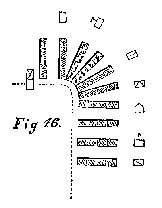
(Fig.
46.) At the command march, the first file will wheel; if
to the side of the front rank man, the latter will take care not to turn
at once, but to describe a short arc of a circle, shortening a little the
first five or six steps in order to give time to the fourth man of this
file to conform himself to the movement. If the wheel be to
the side of the rear rank, the front rank man will wheel in the step it
twenty-eight inches, and the fourth man will conform himself to the movement
by describing a short arc of a circle as has been explained. Each
file will come to wheel on the same ground where that which preceded it
wheeled.
The
instructor will see that the wheel be executed according to these principles,
in order that the distance between the files may always be preserved, and
that there be no check or hindrance at the wheeling point.
To halt the company marching by the flank, and to face it to the front.
239. To effect these objects, the instructor will command:
1. Company. 2. HALT. 3. FRONT.
The
second and third commands will be executed as prescribed :n the school
of the soldier. As soon as the files have undoubled the rear rank
will close to its proper distance. The captain and covering sergeant,
as well as the left guide, if the march be by the left flank, will return
to their habitual places in line at the instant the company faces to the
front.
The
instructor may then align the company by one of the means prescribed.
The company being in march by the flank, to form it on the right (or left) by file into line of battle.
240. If the company be marching by the right flank, the instructor will command:
1. On the right, by file into line. 2. MARCH.
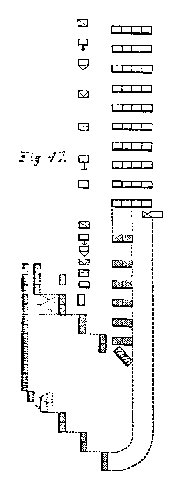
(Fig.
47.) At the command march, the rear rank men doubled will
mark time; the captain and the covering sergeant will turn to the right,
march straight forward, and be halted by the instructor when they shall
have passed at least six paces beyond the rank of file-closers; the captain
will place himself correctly on the line of battle, and will direct the
alignment as the men of the front rank successively arrive; the covering
sergeant will place himself behind the captain at the distance of the rear
rank; the two men on the right of the front rank doubled, will continue
to march, and passing beyond the covering sergeant and the captain, will
turn to the right; after turning, they will continue to march elbow to
elbow, and direct themselves towards the line of battle, but when they
shall arrive at two paces from this line, the even number will shorten
the step so that the odd number may precede him on the line, the odd number
placing himself by the side and on the left of the captain; the even number
will afterwards oblique to the left, and place himself on the left of the
odd number; the next two men of the front rank doubled, will pass in the
same manner behind the two first, turn then to the right, and place themselves,
according to the means just explained, to the left, and by the side of,
the two men already established on the line; the remaining files of this
rank will follow in succession, and be formed to the left in the same manner.
The rear rank
doubled will execute
the movement in the manner already explained for the front rank, taking
care not to commence the movement until four men of the front rank are
established on the line of battle; the rear rank men, as they arrive on
the line, will cover accurately their file leaders.
If
the company be marching by the left flank, the instructor will cause it
to form by file on the left into line of battle, according to the same
principles and by the same commands, substituting the indication left
for right. In this case, the odd numbers will shorten
the step, so that the even numbers may precede them on the line.
The captain, placed on the left of the front rank, and the left guide,
will return to their places in line of battle, by order of the instructor,
after the company shall be formed and aligned.
To
enable the men the better to comprehend the mechanism of this movement,
the instructor will at first cause it to be executed separately by each
rank doubled, and afterwards by the two ranks united and doubled.
The company being in march by the flank, to form it by company, or by platoon, into line, and to cause it to face to the right and left in marching.
241. The company being in march by the right flank, the instructor will order the captain to form it into line; the captain will immediately command:
1. By company into line. 2. MARCH.

(Fig.
48.) At the command march, the covering sergeant will continue
to march straight forward; the men will advance the right shoulder, take
the double quick step, and move into line by the shortest route, taking
care to undouble the files, and to come on the line one after the other.
As
the front rank men successively arrive in line with the covering sergeant,
they will take from him the step, and then turn their eyes the front.
The
men of the rear rank will conform to the movements of their respective
file leaders, but without endeavoring to arrive in line at the same time
with the latter.
At
the instant the movement begins, the captain will face to his company in
order to follow up the execution; and, as soon as the company is formed,
he will command, guide left, place himself two paces before
the centre, face to the front, and take the step of the company.
At
the command guide left, the second sergeant will promptly
place himself in the front rank, on the left, to serve as guide, and the
covering sergeant who is on the opposite flank will remain there.
When
the company marches by the left flank, this movement will be executed by
the same commands, and according to the same principles; the company being
formed, the captain will command guide right, and place himself
in front of his company as above; the covering sergeant who is on the right
of the front rank will serve as guide, and the second sergeant placed on
the left flank will remain there.
Thus,
supposing the company to constitute a part of a column by company, right
or left in front, the covering sergeant and the second sergeant of each
company will always be placed on the right and left, respectively, of the
front rank; they will be denominated right guide and left
guide, and the one or the other charged with the direction.
The
company being in march by the flank, if it be the wish of the instructor
to cause it to form platoons, he will give an order to that effect to the
captain, who will command:
1. By platoon, into line. 2. MARCH.
The
movement will be executed by each platoon according to the above principles.
The captain will place himself before the centre of the first platoon,
and the first lieutenant before the centre of the second, passing through
the opening made in the centre of the company, if the march be by the right
flank, and around the left of his platoon, if the march be by the left
: in this last case,
the captain will also
pass around the left of the second platoon in order to place himself in
front of the first. Both the captain and lieutenant, without waiting
for each other, will command guide left (or right)at
the instant their respective platoons are formed.
At
the command guide left (or right), the
guide of each platoon will pass rapidly to the indicated flank of the platoon,
if not already there.
The
right guide of the company will always serve as the guide of the right
or left of the first platoon, and the left guide of the company will serve,
in like manner, as the guide of the second platoon.
Thus
in a column, by platoon, there will be but one guide to each platoon; he
will always be placed on its left flank, if the right be in front, and
on the right flank, if the left be in front.
In
these movements, the file-closers will follow the platoons to which they
are attached.
The
instructor may cause the company, marching by the flank to form by company,
or by platoon, into line, by his own direct commands, using those prescribed
for the captain.
The
instructor will exercise the company in passing, without halt from the
march by the front, to the march by the flank, and reciprocally.
In either ease, he will employ the commands prescribed in the school of
the soldier, substituting company for squad.
The company will face to the right or left, in marching, and the captain,
the guides, and file-closers will conform themselves to what is prescribed
for each in the march by the flank, or in the march by the front of a company
supposed to be a subdivision of a column.
If,
after facing to the right or left, in marching, the company find itself
faced by the rear rank, the captain will place himself two paces behind
the centre of the front rank, now in the rear, the guides will pass to
the rear rank, now leading and the file-closers
will march in front
of this rank.
The
instructor, in order to avoid fatiguing the men, and to prevent them from
being negligent in the position of shoulder arms, will sometimes order
support arms in marching by the flank, and arms on the right shoulder,
when marching in line.
To break into column by platoon, either at a halt or in march.
242. The company being at a halt, in line of battle, the instructor, wishing to break it into column, by platoon to the right, will command:
1. By platoon, right wheel. 2. MARCH.
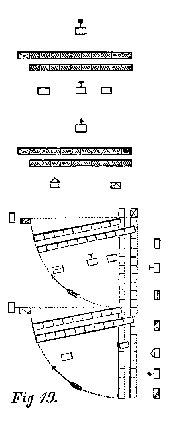
(Fig.
49.) At the first command, the chiefs of platoons will rapidly place themselves
two paces before the centres of their respective platoons, the lieutenant
passing around the left of the company. They need not occupy themselves
with dressing, one upon the other. The covering sergeant will replace
the captain in the front rank.
At
the command march, the right front rank man of each platoon
face to the right, the covering sergeant standing fast the chief of each
platoon will move quickly by the shortest line, a little beyond the point
at which the marching flank will rest when the wheel shall be completed,
face to the late rear, and place himself so that the line which he forms
with the man on right (who had faced), shall be perpendicular to that occupied
by the company in line of battle; each platoon will wheel according to
the principles prescribed for the wheel on a fixed pivot, and when the
man who conducts the marching flank shall approach near to the perpendicular,
its chief will command:
1. Platoon. 2. HALT.
At
the command halt, which will be given at the instant
the man who conducts the marching flank shall have arrived at three paces
from the perpendicular, the platoon will halt; the covering sergeant will
move to the point where the left of the first platoon is to rest, passing
by the front rank; the second sergeant will place himself in like manner,
in respect to the second platoon. Each will take care to leave between
himself and the man on the right of his platoon, a space equal to its front;
the captain and first lieutenant will look to this, and each take care
to align the sergeant between himself and the man of the platoon who had
faced to the right.
The
guide of each platoon, being thus established on the perpendicular, each
chief will place himself two paces outside of his guide, and facing towards
him, will command:
3. Left - DRESS.
The alignment being ended, each chief of platoon will command, FRONT,
and
place himself two paces before its centre.
The
file-closers will conform themselves to the movement of their respective
platoons, preserving always the distance of two paces from the rear rank.
The
company will break by platoon to the left, according to the same principles.
The instructor will command:
1. By platoon, left wheel. 2. MARCH.
The
first command will be executed in the same manner as breaking by platoon
to the right.
At
the command march, the left front rank man of each
platoon will face to the left, and the platoons will wheel to the left,
according to the principles prescribed for the wheel on a fixed pivot;
the chiefs of platoon will conform to the principles indicated.
At
the command halt, given by the chief of each platoon, the
covering sergeant on the right of the front rank of the first platoon and
the second sergeant near the left of the second platoon, will each move
to the points where the right of his platoon is to rest. The chief
of each platoon should be careful to align the sergeant between himself
and the man of the platoon who had faced to the left, and will then command:
Right - DRESS.
The
platoons being aligned, each chief of platoon will command FRONT, and
place himself opposite its centre.
243.
The instructor wishing to break the company by platoon to the right, and
to move the column forward after the wheel is completed, will caution the
company to that effect, and command:
1. By platoon, right wheel. 2. MARCH.
At
the first command, the chiefs of platoon will move rapidly in front of
their respective platoons, conforming to what has been prescribed, and
will remain in this position during the continuance the wheel. The
covering sergeant will replace the chief of the first platoon in the front
rank.
At
the command march, the platoons will wheel to the
right, conforming to the principles herein prescribed; the man on the pivot
will not face to the right, but will mark time, conforming himself the
movement of the marching flank; and when the man who is the left of this
flank shall arrive near the perpendicular, the instructor will command:
3. Forward. 4. MARCH. 5. Guide left.
At
the fourth command, which will be given at the instant the wheel is completed,
the platoons will move straight to the front, all the men taking the step
of twenty-eight inches. The covering sergeant and the second sergeant
will move rapidly to the left of their respective platoons, the former
passing before the front rank. The leading guide will immediately
take points on the ground in the direction which may be indicated to him
by the instructor.
At
the fifth command, the men will take the touch of elbows lightly to the
left.
If
the guide of the second platoon should lose his distance, or the line of
direction, he will conform to the principles herein prescribed.
If
the company be marching in line to the front, the instructor will cause
it to break by platoon to the right by the same commands. At the
command march, the platoons will wheel in the manner
already explained; the man on the pivot will take care to mark time in
his place, without advancing or receding; the instructor, the chiefs of
platoon, and the guides, will conform to what has been prescribed.
The
company may be broken by platoons to the left, according to same principles,
and by inverse means, the instructor giving the commands prescribed, substituting
left
for right, and reciprocally.
To march in column.
244.
The company having broken by platoon, right (or left) in front, the instructor,
wishing to cause the column to march, will throw himself twenty-five or
thirty paces in front, face to the guides, place himself correctly, on
their direction, and caution the leading guide to take points on the ground.
The
instructor being thus placed, the guide of the leading platoon will take
two points on the ground in the straight line passing between his own and
the heels of the instructor.
These
dispositions being made, the instructor will step aside, and command:
1. Column forward. 2. Guide left (or right). 3. MARCH.
At
the command march, promptly repeated by the chiefs
of platoon, they, as well as the guides, will lead off, by a decided step,
their respective platoons, in order that the whole may move smartly, and
at the same moment.
The
men will each feel lightly the elbow of his neighbor toward the guide,
and conform himself, in marching, to the principles prescribed in the school
of the soldier. The man next to the guide, in each platoon, will
take care never to pass him, and also to march always about six inches
to the right (or left) from him, in order not to push him out of the direction.
The
leading guide will observe, with the greatest precision, the length and
cadence of the step, and maintain the direction of his march by the means
prescribed.
The
following guide will march exactly in the trace of the leading one, preserving
between the latter and himself a distance precisely equal to the front
of his platoon, and marching in the same step with the leading guide.
To change direction.
The
changes of direction of a column while marching, will be executed
according to the principles prescribed for wheeling on the march.
Whenever, therefore, a column is to change direction, the instructor will
change the guide, if not already there, to the flank opposite the side
to which the change is to be made.
245.
The column being in march right in front, if it be the wish of the instructor
to change direction to the right, he will give the order to the chief of
the first platoon, and immediately go himself, or
send a marker to the point at which the change of direction is to be made;
the instructor, or marker, will place himself on the direction of the guides,
so as to present the breast to that flank of the column.
The
leading guide will direct his march on that person, so that, in passing,
his left arm may just graze his breast. When the leading guide shall
have approached near to the marker, the chief of the platoon will command:
1. Right wheel. 2. MARCH.
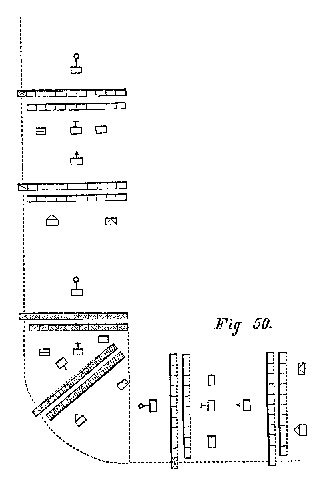
(Fig.
50.) The first command will be given when the platoon is at the distance
of four paces from the marker.
At
the command march, which will be pronounced at the
instant the guide shall have arrived opposite the marker, the platoon will
wheel to the right, conforming to what is prescribed in the school of the
soldier.
The
wheel being finished, the chief of each platoon will command:
3. Forward. 4. MARCH.
These
commands will be pronounced and executed as is prescribed in the school
of the soldier. The guide of the first platoon will take points on
the ground in the new direction, in order the better to regulate the march.
The
second platoon will continue to march straight forward till up with the
marker, when it will wheel to the right, and re-take the direct march by
the same commands and the same means which governed the first platoon.
The
column being in march right in front, if the instructor should wish to
change direction to the left, he will command, guide right. At
this command, the two guides will move rapidly to the right of their respective
platoons, each passing in front of his subdivision; the men will take the
touch of elbows to the right; the instructor will afterwards conform to
what is prescribed.
The
change of direction to the left will then be executed according to the
same principles as the change of direction to the right, but by inverse
means.
When
the change of direction is completed, the instructor will command, guide
left.
The
changes of direction in a column, left in front will be executed according
to the same principles.
In
changes of direction in double quick time, the platoons will wheel according
to the principles prescribed in the school of the soldier.
In
order to prepare the men for those formations in line, which can be executed
only by turning to the right or the left, the instructor will sometimes
cause the column to change direction to the side of the guide. In
this case, the chief of the leading platoon will command: Left(or
right)
turn,
instead of left(or
right)wheel.
The subdivisions will each turn, in succession, conforming to what
is prescribed in the school of the soldier. The leading guide, as
soon as he has turned, will take points on the ground, the better to regulate
the direction of the march.
To halt the column.
The column being in march, when the instructor shall wish to halt it, he will command:
1. Column. 2 HALT.
At
the second command, promptly repeated by the chiefs of platoon, the column
will halt; the guides also will stand fast, although they may have lost
both distance and direction.
If
the command halt be not repeated with the greatest vivacity,
and executed at the same instant, distances will be lost.
If
a guide, having lost his distance, seek to recover it after that command,
he will only throw his fault on the following guide, who, if he have marched
well, will no longer be at his proper distance; and if the latter regain
what he has thus lost, the movement will be propagated to the rear of the
column.
Being in column by platoon, to form to the right or left into line of battle, either at a halt or on the march.
246. The instructor having halted the column, right in front, and wishing to form it into line of battle, will place himself at platoon distance in front of the leading guide, face to him, and rectify, if necessary, the position of the guide beyond; which being executed, he will command:
Left - DRESS.
At
this command, which will not be repeated by the chiefs of platoon, each
of them will place himself briskly two paces outside of his guide, and
direct the alignment of the platoon perpendicularly to the direction of
the column.
Each
chief having aligned his platoon, will command FRONT, and return
quickly to his place in column.
This
disposition being made, the instructor will command:
1. Left into line, wheel. 2. MARCH.

(Fig. 51.) At the command march, briskly repeated by the chiefs of platoon, the front rank man on the left of each platoon will face to the left, and place his breast lightly against the arm of the guide by his side, who stands fast; the platoons will wheel to the left on the principle of wheels from a halt, and in conformity to what is prescribed. Each chief will turn to his platoon to observe its movement, and when the marching flank has approached near the line of battle, he will command:
1. Platoon. 2. HALT.
The
command halt will be given when the marching flank of the
platoon is three paces from the line of battle.
The
chief of the second platoon having halted it, will return to his place
as a file-closer, passing around the left of his subdivision.
The
captain having halted the first platoon, will move rapidly to the point
at which the right of the company will rest in line of battle, and command:
Right - DRESS.
At
this command, the two platoons will dress up on the alignment; the front
rank man on the right of the leading platoon, who finds himself opposite
the instructor established on the direction of the guides, will place his
breast lightly against the left arm of this officer. The captain
will direct the alignment from the right on the man on the opposite flank
of the company.
The
company being aligned, the captain will command:
FRONT.
The instructor seeing the company in line of battle, will command:
Guides - POSTS.
At
this command, the covering sergeant will cover the captain, and the left
guide will return to his place as a file-closer.
If
the column be left in front, and the instructor should wish to form it
to the right into line of battle, he will place himself at platoon distance
in front of the leading guide, face to him, and rectify, if necessary,
the position of the guide beyond; which being executed, he will command:
1. Right into line, wheel. 2. MARCH.
At the command march, the front rank man on the right of each platoon will face to the right and place his breast lightly against the left arm of the guide by his side, who stands fast; each platoon will wheel to the right, and will be halted by its chief, when the marching flank has approached near the line of battle; for this purpose, the chief of each platoon will command:
1. Platoon. 2. HALT.
The
command halt will be given when the marching flank of the
platoon is three paces from the line of battle. The chief of the
second platoon having halted his platoon, will resume his place in the
rank of file-closers.
The
captain having halted the first platoon, will move briskly to the point
at which the left of the company will rest, and command:
Left - DRESS.
At
this command, the two platoons will dress up on the alignment; the man
on the left of the second platoon, opposite the instructor, will place
his breast lightly against the right arm of this officer, and the captain
will direct the alignment from the left on the man on the opposite flank
of the company.
The
company being aligned, the captain will command:
FRONT.
The instructor will afterwards command:
Guides - POSTS.
At
this command, the captain will move to the right of his company, the covering
sergeant will cover him, and the left guide will return to his place as
a file-closer.
247.
If the column be marching right in front and the instructor should wish
to form it into line without halting the column, he will give the command:
1. Left into line, wheel. 2. MARCH.
and will himself move
rapidly to platoon distance in front of the leading guide.
At
the command march, briskly repeated by the chiefs
of platoons, the front rank man on the left of each platoon will face to
the left, and place his breast lightly against the arm of the guide by
his side, who stands fast; the platoons will wheel to the left on the principle
of wheels from a halt. Each chief will turn to his platoon to observe
its movement, and conform to what is prescribed for wheeling into line
from a halt.
If
the column be in march left in front, this formation will be made according
to the same principles, and by inverse means.
248.
If the column be marching right in front, and the instructor should wish
to form it into line without halting the column, and to march the company
in line to the front, he will command:
1. By platoons left wheel. 2. MARCH.
At the command march, briskly repeated by the chiefs of platoon, the left guides will halt; the man next to the left guide in each platoon will mark time: the platoons will wheel to the left, conforming to the principles of the wheel on a fixed pivot. When the right of the platoons shall arrive near the line of battle, the instructor will command:
3. Forward. 4. MARCH. 5. Guide right (or left.)
At
the fourth command, given at the instant the wheel is completed, all the
men of the company will move off together with the step of twenty-eight
inches; the captain, the chief of the second platoon, the covering sergeant,
and the left guide, will take their positions as in line of battle.
At
the fifth command, which will be given immediately after the fourth, the
captain and covering sergeant, if not already there, will move briskly
to the side on which the guide is designated. The non-commissioned
officer charged with the direction will move rapidly in front of the guide,
and will be assured in his line of march by the instructor. That
non-commissioned officer will immediately take points on the ground.
The men will take the touch of elbows to the side of the guide, conforming
themselves to the principles of the march in line.
The
same principles are applicable to a column left in front.
A company marching to the front to break it into platoons, and to re-form the company.
249. The company marching in the cadenced step, and supposed to make part of a column, right in front, in which case the guide is left, when the instructor shall wish to cause it to break by platoon, he will give the order to the captain, who will command:
1. Break into platoons,
and immediately place
himself before the centre of the first platoon.
At
the command break into platoons, the first lieutenant
will pass quickly around the left to the centre of his platoon, and give
the caution: Mark time.
The
captain will then command:
2. March.
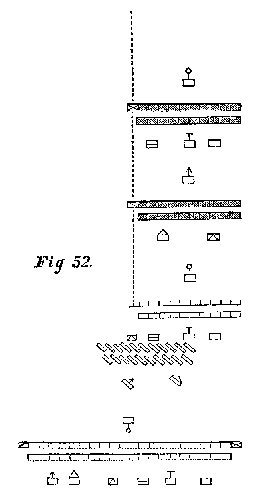
(Fig.
52). The first platoon will continue to march straight forward; the covering
sergeant will move rapidly to the left flank of this platoon (passing by
the front rank) as soon as the flank shall be disengaged.
At
the command march, given by the captain, the second
platoon will begin to mark time; its chief will immediately add:
1. Right oblique. 2. MARCH.
The
last command will he given so that this platoon may commence obliquing
the instant the rear rank of the first platoon shall have passed.
The men will shorten the step in obliquing, so that when the command forward
march is given, the platoon may have its exact distance.
The
guide of the second platoon being near the direction of the guide of the
first, the chief of the second will command Forward, and
add MARCH,
the instant that the guide of his platoon shall cover
the guide of the first.
In
a column, left in front the company will break into platoons by inverse
means applying to the first platoon all that has been prescribed for the
second, and reciprocally.
In
this case, the left guide of the company will shift to the right flank
of the second platoon, and the covering sergeant will remain on the right
of the first.
250.
The column, by platoon, being in march, right in front, when the instructor
shall wish to cause it to form company, he will give the order to the captain,
who will command:
Form company.
Having given this command, the captain will immediately add:
1. First platoon. 2. Right oblique.
The
chief of the second platoon will caution it to continue to march straight
forward.
The
captain will then command:
3. MARCH.
At
this command, repeated by the chief of the second, the first platoon will
oblique to the right, in order to unmask the second; the covering sergeant,
on the left of the first platoon, will return to the right of the company,
passing by the front rank.
When
the first platoon shall have nearly unmasked the second, the captain will
command:
1. Mark time,
and at the instant the unmasking shall be complete, he will add:
2. MARCH.
The
first platoon will then cease to oblique, and mark time.
In
the mean time the second platoon will have continued to march straight
forward, and when it shall be nearly up with the first, the captain will
command Forward, and at the instant the two platoons shall
unite, add MARCH; the first platoon will then cease to mark time.
In
a column, left in front, the same movement will be executed by inverse
means, the chief of the second platoon giving the command Forward,and
the captain adding the command MARCH, when the platoons are united.
The
guide of the second platoon, on its right, will pass to its left flank
the moment the platoon begins to oblique; the guide of the first, on its
right, remaining on that flank of the platoon.
The
instructor will also sometimes cause the company to break and re-form,
by platoon, by his own direct commands. In this case, he will give
the general commands prescribed for the captain above:
1. Break into platoons. 2. MARCH.
and,
1. Form company. 2. MARCH.
If, in breaking the company into platoons, the subdivision that breaks off should mark time too long, it might, in a column of many subdivisions, arrest the march of the following one, which would cause a lengthening of the column, and a loss of distances.
Being in column, to break files to the rear, and to cause them to re-enter into line.
251. The company being in march, and supposed to constitute a subdivision of a column, right (or left) in front, when the instructor shall wish to cause files to break off he will give the order to the captain, who will immediately turn to his company, and command:
1. Two files from left (or right) to rear. 2. MARCH.
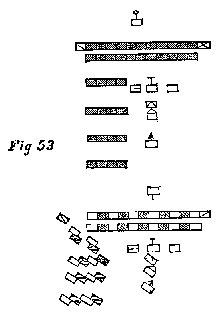
(Fig.
53.) At the command march, the two files on the left
(or right) of the company will mark time, the others will continue to march
straight forward; the two rear rank men of these files will, as soon as
the rear rank of the company shall clear them, move to the right by advancing
the outer shoulder; the odd number will place himself behind the third
file from that flank, the even number behind the fourth, passing for this
purpose behind the odd number; the two front rank men will, in like manner,
move to the right when the rear rank of the company shall clear them, the
odd number will place himself behind the first file, the even number behind
the second file, passing for this purpose behind the odd number.
If the files are broken from the right, the men will move to the left advancing
the outer shoulder, the even number of the rear rank will place himself
behind the third file, the odd number of the same rank behind the fourth;
the even number of the front rank behind the first file, the odd number
of the same rank behind the second the odd numbers for this purpose passing
behind the even numbers. The men will be careful not to lose their
distances, and to keep aligned.
If
the instructor should still wish to break two files from the same side,
he will give the order to the captain, who will proceed as above directed.
At
the command march, given by the captain, the files
already broken, advancing a little the outer shoulder, will gain the space
of two files to the right, if the files are broken from the left, and to
the left, if the files are broken from the right, shortening, at the same
time, the step, in order to make room between themselves and the rear rank
of the company for the files last ordered to the rear; the latter will
break by the same commands and in the same manner as the first. The
men who double should increase the length of the step in order to prevent
distances from being lost.
The
instructor may thus diminish the front of a company by breaking off successive
groups of two files, but the new files must always be broken from the same
side.
The
instructor, wishing to cause files broken off to return into line, will
give the order to the captain, who will immediately command:
1. Two files into line. 2. MARCH.
At
the command march, the first two files of those marching
by the flank will return briskly into line, and the others will gain the
space of two files by advancing the inner shoulder towards the flank to
which they belong.
The
captain will turn to his company, to watch the observance of the principles
which have just been prescribed.
The
instructor having caused groups of two files to break one after another,
and to return again into line, will afterwards cause two or three groups
to break together, and for this purpose, will command: Four or six
files from left (or right) to rear; MARCH.
The
files designated will mark time; each rank will advance a little the outer
shoulder as soon as the rear rank of the company shall clear it, will oblique
at once, and each group will place itself behind the four neighboring files,
and in the same manner, as if the movement had been executed group by group,
taking care that the distances are preserved.
The
instructor will next order the captain to cause two or three groups to
be brought into line at once, who turning to the company, will command:
Four or six flies into line - MARCH.
At
the command march, the files designated will advance
the inner shoulder, move up and form on the flank of the company by the
shortest lines.
As
often as files shall break off to the rear, the guide on that flank will
gradually close on the nearest front rank man remaining in line, and he
will also open out to make room for files ordered into line.
The
files which march in the rear are disposed in the following order: the
left files as if the company was marching by the right flank, and the right
files as if the company was marching by the left flank. Consequently,
whenever there is on the right or left of a subdivision, a file which does
not belong to a group, it will be broken singly.
It
is necessary to the preservation of distances in column that the men should
be habituated in the schools of detail to execute the movements of this
article with precision.
If
new files broken off do not step well to the left or right in obliquing;
if, when files are ordered into line, they do not move up with promptitude
and precision, in either case the following files will be arrested in their
march, and thereby cause the column to be lengthened out.
The
instructor will place himself on the flank from which the files are broken,
to assure himself of the exact observance of the principles.
Files
will only be broken off from the side of direction, in order that the whole
company may easily pass from the front to the flank march.
To march the column in route, and to execute the movements incident thereto.
252. The swiftness of the route step will be 110 steps in a minute;
this swiftness will be habitually maintained in column in route, when the
roads and ground may permit.
The
company being at a halt, and supposed to constitute a subdivision of a
column, when the instructor shall wish to cause it to march in the route
step, he will command:
1. Column, forward. 2. Guide, left (or right). 3. Route step. 4. MARCH.
At
the command march, repeated by the captain, the two
ranks will step off together; the rear rank will take, in marching, by
shortening a few steps, a distance of one pace (twenty-eight inches) from
the rank preceding, which distance will be computed from the breasts of
the men in the rear rank, to the knapsacks of the men in the front rank.
The men, without further command, will immediately carry their arms at
will, as indicated in the school of the soldier. They
will no longer be required to march in the cadenced pace, or with the same
foot, or to remain silent. The files will march at ease; but care
will be taken to prevent the ranks from intermixing, the front rank from
getting in advance of the guide, and the rear rank from opening to too
great a distance.
The
company marching in the route step, the instructor will cause it to change
direction, which will be executed without formal commands, on a simple
caution from the captain; the rear rank will come up to change direction
in the same manner as the front rank. Each rank will conform itself
although in the route step, to the principles which have been prescribed
for the change in closed ranks, with this difference only; that the pivot
man, instead of taking steps of nine, will take steps of fourteen inches,
in order to clear the wheeling point
The
company marching in the route step, to cause it to pass to the cadenced
step, the instructor will first order pieces to be brought to the shoulder,
and then command:
1. Quick time. 2. MARCH.
At
the command march, the men will resume the cadenced
step, and will close so as to leave a distance of sixteen inches between
each rank.
253.
The company marching in the cadenced pace, the instructor, to cause it
to take the route step will command:
1. Route step. 2. MARCH.
At
the command march, the front rank will continue the
step of twenty-eight inches, the rear rank will take, by gradually shortening
the step, the distance of twenty-eight inches from the front rank: the
men will carry their arms at will.
The
instructor will exercise the company in increasing and diminishing front,
by platoon, which will be executed by the same commands, and the same means,
as if the company were marching in the cadenced step. When the company
breaks into platoons, the chief of each will move to the flank of his platoon,
and will take the place of the guide, who will step back into the rear
rank.
254.
The company being in column, by platoon, and marching in the route step,
the instructor can cause the front to be diminished and increased, by section,
if the platoons have a front of twelve files or more.
The
movements of diminishing and increasing front, by section, will be executed
according to the principles indicated for the same movement by platoon.
The right sections of platoons will be commanded by the captain and first
lieutenant, respectively; the left sections, by the two next subalterns
in rank, or, in their absence, by sergeants.
The
instructor wishing to diminish by section, will give the order to the captain,
who will command:
1. Break into sections. 2. MARCH.
As
soon as the platoons shall be broken, each chief of section will place
himself on its directing flank in the front rank, the guides who will he
thus displaced, will fall back into the rear rank: the file-closers will
close up to within one pace of this rank.
Platoons
will be broken into sections only in the column in route, the movement
will never he executed in the manoeuvres, whatever may be the front of
the company.
When
the instructor shall wish to re-form platoons, he will give the order to
the captain, who will command:
1. Form platoons. 2. MARCH.
At
the first command, each chief of section will place himself before its
centre, and the guides will pass into the front rank. At the command
march,
the movement will be executed as has been prescribed for forming company.
The moment the platoons are formed, the chiefs of the left sections will
return to their places as file-closers.
The
instructor will also cause to be executed the diminishing and increasing
front by files, as prescribed in the preceding article, and in the same
manner, as if marching in the cadenced step. When the company is
broken into sections, the subdivisions must not be reduced to a front of
less than six files, not counting the chief of the section.
The
company being broken by platoon, or by section, the instructor will cause
it, marching in the route step, to march by the flank in the same direction,
by the commands and the means indicated. The moment the subdivisions
shall face to the right (or left), the first file of each will wheel to
the left (or right), in marching, to prolong the direction, and to unite
with the rear file of the subdivision immediately preceding. The
file-closers will take their habitual places in the march by the flank,
before the union of the subdivisions.
255.
If the company be marching by the right flank, and the instructor should
wish to undouble the files, which might sometimes be found necessary, he
will inform the captain, who, after causing the cadenced step to be resumed,
and arms to be shouldered or supported, will command:
1. In two ranks, undouble files. 2. MARCH.
At
the second command, the odd numbers will continue to march straight forward,
the even numbers will shorten the step, and obliquing to the left will
place themselves promptly behind the odd numbers; the rear rank will gain
a step to the left so as to re-take the touch of elbows on the side of
the front rank.
If
the company be marching by the left flank, it will be the even numbers
who will continue to march forward, and the odd numbers who will undouble.
If
the instructor should wish to double the files, he will give the order
to the captain, who will command:
1. In four ranks, double files. 2. MARCH.
At
the command march, the files will double in the manner
as explained, when the company faces by the right or the left flank.
The instructor will afterwards cause the route step to be resumed.
The
various movements prescribed in this lesson may be executed in double quick
time. The men will be brought, by degrees, to pass over at this gait
about 1100 yards in seven minutes.
When
the company marching in the route step shall halt, the rear rank will close
up at the command halt, and the whole will shoulder
arms.
Marching
in the route step, the men will be permitted to carry their pieces in the
manner they shall find most convenient, paying attention only to holding
the muzzles up, so as to avoid accidents.
Countermarch.
256. The company being at a halt, and supposed to constitute a part of a column, right in front, when the instructor shall wish it cause it to countermarch, he will command:
l. Countermarch. 2. Company, right - FACE. 3. By file left. 4. MARCH.

(Fig.
54.) At the second command, the company will face to the right, the two
guides to the right about; the captain will go to the right of his company
and cause two files to break to the rear, and then place himself by the
side of the front rank man, to conduct him.
At
the command march, both guides will stand fast; the
company will step off smartly; the first file, conducted by the captain,
will wheel around the right guide, and direct its march along the front
rank so as to arrive behind, and two paces from the left guide; each file
will come in succession to wheel on the same ground around the right guide;
the leading file having arrived at a point opposite to the left guide,
the captain will command:
1. Company. 2. HALT. 3. FRONT. 4. Right - DRESS.
The
first command will be given at four paces from the point
where the leading file is to rest.
At
the second command, the company will halt.
At
the third, it will face to the front.
At
the fourth, the company will dress by the right; the captain will step
two paces outside of the left guide, now on the right, and direct the alignment,
so that the front rank may be enclosed between the two guides: the company
being aligned, he will command FRONT, and place himself before the
centre of the company as if in column; the guides, passing along the front
rank, will shift to their proper places, on the right and left of that
rank.
In
a column, by platoon, the countermarch will be executed by the same commands,
and according to the same principles; the guide of each platoon will face
about, and its chief will place himself by the side of the file on the
right, to conduct it.
In
a column, left in front, the countermarch will be executed by inverse commands
and means, but according to the same principles. Thus, the movement
will be made by the right flank of subdivisions if the right be in front,
and by the left flank, if the left be in front; in both cases the subdivisions
will wheel by file to the side of the front rank.
Being in column by platoon, to form on the right (or left) into line of battle.
257. The column by platoon, right in front, being in march, the instructor wishing to form it on the right into line of battle, will command:
1. On the right into line. 2. Guide right.
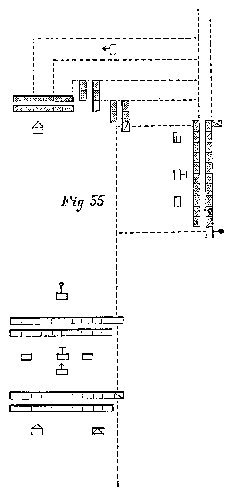
(Fig.
55.) At the second command, the guide of each platoon will shift quickly
to its right flank, and the men will touch elbows to the right; the column
will continue to march straight forward.
The
instructor having given the second command, will move briskly to the point
at which the right of the company ought to rest in line, and place himself
facing the point of direction to the left which he will choose.
The
line of battle ought to be so chosen that the guide of each platoon, after
having turned to the right, may have at least ten paces to take before
arriving upon that line.
The
head of the column being nearly opposite to the instructor, the chief of
the first platoon will command; 1. Right turn; and
when exactly opposite to that point, he will add:
2. MARCH.
At the command march, the first platoon will turn to the right, in conformity with the principles prescribed in the school of the soldier. Its guide will so direct his march as to bring the front rank man next on his left, opposite to the instructor the chief of the platoon will march before its centre; and when its guide shall be near the line of battle, he will command:
1. Platoon. 2. HALT.
At the command halt, which will be given at the instant the right of the platoon shall arrive at the distance of three paces from the line of battle, the platoon will halt; the files not yet in line will come up promptly. The guide will throw himself on the line of battle, opposite to one of the three left files of his platoon; he will face to the instructor, who will align him on the point of direction to the left. The chief of platoon having, at the same time, gone to the point where the right of the company is to rest, will, a soon as he sees all the files of the platoon in line, command:
Right - DRESS.
At
this, the first platoon will align itself; the front rank man, who finds
himself opposite to the guide, will rest his breast lightly against the
right arm of this guide, and the chief of the platoon, from the right,
will direct the alignment on this man.
The
second platoon will continue to march straight forward, until its guide
shall arrive opposite to the left file of the first; it will then turn
to the right at the command of its chief; and march towards the line of
battle, its guide directing himself on the left file of the first platoon.
The
guide having arrived at the distance of three paces from the line of battle,
this platoon will be halted, as prescribed for the first; at the instant
it halts, its guide will spring on the line of battle, opposite to one
of the three left files of his platoon, and will be assured in his position
by the instructor.
The
chief of the second platoon, seeing all its files in line, arid its guide
established on the direction, will command:
Right - DRESS.
Having given this command, he will return to his place as a file-closer, passing around the left; the second platoon will dress up on the alignment of the first, and, when established, the captain will command:
FRONT.
The movement ended, the instructor will command:
Guides - POSTS.
At
this command, the two guides will return to their places in line of battle.
A
column by platoon, left in front, will form on the left into line of battle,
according to the same principles, and, by inverse means, applying to the
second platoon what is prescribed for the first, and reciprocally.
The chief of the second platoon having aligned it, from the point of appui
(the left), will retire to his place as a file-closer. The captain
having halted the first platoon three paces behind the line of battle,
will go to the same point to align the platoon, and then command: FRONT.
At the command, guides - posts, given by the instructor,
the captain will shift to his proper flank, and the guides take their places
in the line of battle.
Formation of a company from two ranks into four, and reciprocally, at a halt, and in march.
258.
The company being formed in two ranks, at a halt, and supposed to form
part of a column right in front when the instructor shall wish to form
it into four ranks, he will command:
At the second command, the left guide will remain faced to the front, the
company will face to the left: the rear rank will gain the distance of
one pace from the front rank by a side step to the left and rear, and the
men will form into four ranks as prescribed in the school of the soldier.
At
the command march, the first file of four men will
reface to the front without undoubling. All the other files of four
will step if, and closing successively to about five inches of the preceding
file, will halt, and immediately face to the front, the men remaining doubled.
The
file-closers will take their new places in line of battle, at two paces
in rear of the fourth rank.
The
captain will superintend the movement.
259.
The company being in four ranks, when the instructor shall wish to form
it into two ranks, he will command:
1. In two ranks, form company. 2. Company right - FACE. 3. MARCH (or double quick - MARCH).
At
the second command the left guide will stand fast, the company will face
to the right.
At
the command march, the right guide will step off and
march in the prolongation of the front rank. The leading file of
four men will step off at the same time, the other files standing fast;
the second file will step off when there shall be between it and the first
space sufficient to form it into two ranks. The following files will
execute successively what has been prescribed for the second. As
soon as the last file shall have its distance, the instructor will command:
1. Company. 2. HALT. 3. FRONT.
At
the command front, the company will face to the front, and the files will
undouble.
260.
The company being formed in two ranks, and marching to the front, when
the instructor shall wish to form it into four ranks, he will command:
At the command march, the left guide and the left file of
the company will continue to march straight to the front: the company will
make a half face to the left, the odd numbers placing themselves behind
the even numbers. The even numbers of the rear rank will shorten
their steps a little, to permit the odd numbers of the front rank to get
between them and the even numbers of that rank. The files thus formed
of fours, except the left file, will continue to march obliquely, lengthening
their steps slightly, so as to keep constantly abreast of the guide; each
file will close successively on the file next on its left, and when at
the proper distance from that file, will face to the front by a half face
to the right, and take the touch of elbows to the left.
261.
The company being in march to the front in four rank, when the instructor
shall wish to form it into two ranks, he will command:
1. In two ranks, form company. 2. By the right, undouble files. 3. MARCH (or double quick - MARCH).
At
the command march, the left guide and the left file
of the company will continue to march straight to the front; the company
will make a half face to the right and march obliquely, lengthening the
step a little, in order to keep, as near as possible, abreast of the guide.
As soon as the second file from the left shall have gained to the right
the interval necessary for the left file to form into two ranks, the second
file will face to the front by a half face to the left and march straight
forward; the left file will immediately form into two ranks, and take the
touch of elbows to the left. Each file will execute successively
what has just been prescribed for the file next to the left, and each will
form into two ranks when the file next on its right has obliqued the required
distance and faced to the front.
If
the company be supposed to make part of a column, left in front, these
different movements will be executed according to the same principles and
by inverse means, substituting the indication left for right.
INSTRUCTION FOR SKIRMISHERS.
General principles and division of the instruction.
262.
The movements of skirmishers should be subjected to such as will give to
the commander the means of moving them in any direction with the greatest
promptitude.
It
is not expected that these movements should be executed with the same precision
as in closed ranks, nor is it desirable, as such exactness would materially
interfere with their prompt execution.
When
skirmishers are thrown out to clear the way for, and to protect the advance
of, the main corps, their movements should be so regulated by this corps,
as to keep it constantly covered.
Every
body of skirmishers should have a reserve, the strength and composition
of which will vary according to circumstances.
If
the body thrown out be within sustaining distance of the main corps, a
very small reserve will be sufficient for each company, whose duty it shall
be to fill vacant places, furnish the line with cartridges, relieve the
fatigued, and serve as a rallying point for the skirmishers.
If
the main corps be at a considerable distance, besides the company reserves,
another reserve will be required, composed of entire companies, which will
be employed to sustain and reinforce such parts of the line as may be warmly
attacked; this reserve should be strong enough to relieve at least half
the companies deployed as skirmishers.
The
movements of skirmishers will be executed in quick, or double quick time.
The run will be resorted to only in cases of
urgent necessity.
Skirmishers
will be permitted to carry their pieces in the manner convenient to them.
The
movements will be habitually indicated by the sounds of the bugle.
The
officers, and, if necessary, the non-commissioned officers, will repeat,
and cause the commands to be executed, as soon as they are given; but to
avoid mistakes, when the signals are employed, they will wait until the
last bugle note is sounded before commencing the movement.
Deployments.
263.
A company may be deployed as skirmishers in two ways: forward, and by the
flank.
The
deployment forward will be adopted when the company is behind the line
on which it is to be established as skirmishers: will be deployed by the
flank, when it finds itself already on that line.
Whenever
a company is to be deployed as skirmishers, it will be divided into two
platoons, and each platoon will be subdivided into two sections; the comrades
in battle, forming groups of four men, will be careful to know and to sustain
each other. The captain will assure himself that the files in the
centre of each platoon and section are designated.
The
interval between skirmishers depends on the extent of ground to be covered;
but in general, it is not proper that the groups of four men should be
removed more than forty paces from each other. The habitual distance
between men of the same group in open grounds will be five paces; in no
case will they lose sight of each other.
To deploy forward.
264. A company being at a halt or in march, when the captain shall wish to deploy it forward on the left file of the first platoon, holding the second platoon in reserve, he will command:
1. First platoon - as skirmishers. 2. On the left file - take intervals. 3. MARCH (or double quick - MARCH).
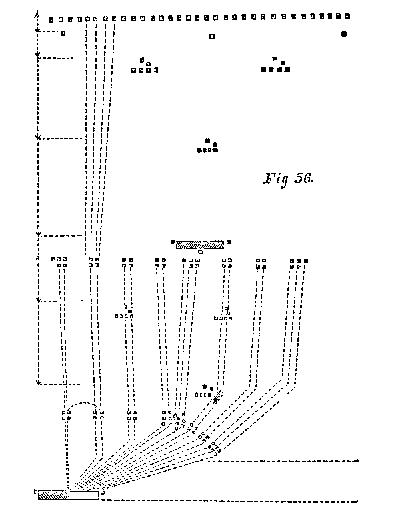
(Fig. 56.) At the first command, the second and third lieutenants will place themselves rapidly two paces behind the centres of the right and left sections of the first platoon; the fifth sergeant will move one pace in front of the centre of the first platoon, and will place himself between the two sections in the front rank as soon as the movement begins; the fourth sergeant will place himself on the left of the front of the same platoon, as soon as he can pass. The captain will indicate to the sergeant the point on which he wishes him to direct his march. The first lieutenant, placing himself before the centre of the second platoon, will command:
Second platoon backward - MARCH.
At
this command, the second platoon will step three paces to the rear so as
to unmask the flank of the first platoon. It will then be halted
by its chief and the second sergeant will place himself on the left, and
the third sergeant on the right flank of the platoon.
At
the command march, the left group of four men, conducted
by the fourth sergeant, will direct itself on the point indicated; all
the other groups of fours throwing forward briskly the left shoulder, will
move diagonally to the front in double quick time, so as to gain to the
right the space of twenty paces, which shall be the distance between each
group and that immediately on its left. When the second group from
the left shall arrive on a line with, and twenty paces from the first,
it will march straight to the front, conforming to the gait and direction
of the first, keeping constantly on the same alignment and at
twenty paces from it. The third group, and all the others, will conform
to what has just been prescribed for the second; they will arrive successively
on the line. The right guilt will arrive with the last group.
The
left guide having reached the point where the left of the line should rest,
the captain will command the skirmishers to halt; the men composing each
group of fours will then immediately deploy at five paces from each other,
and to the right and left of the front rank men of the even file in each
group, the rear rank men placing themselves on the left of their file leaders.
If any groups be not in line at the command halt, they
will move up rapidly, conforming to what has just been prescribed.
If,
during the deployment, the line should be fired upon by the enemy, the
captain may cause the groups of fours to deploy, as they gain their proper
distances.
The
line being formed, the non-commissioned officers on the right, left and
centre of the platoon, will place themselves ten paces in rear of the line,
and opposite the positions they respectively occupied. The chiefs
of sections will promptly rectify any irregularities, and then place themselves
twenty-five or thirty paces in rear of the centre of their sections, each
having with him four men taken from the reserve, and also a bugler, who
will repeat, if necessary, the signals sounded by the captain.
Skirmishers
should be particularly instructed to take advantage of any cover which
the ground may offer, and should lie flat on the ground whenever such a
movement is necessary to protect them from the fire of the enemy.
Regularity in the alignment should yield to this important advantage.
When
the movement begins, the first lieutenant will face the second platoon
about, and march it promptly, and by the shortest line, to
about 150 paces in rear of the centre of the line. He will hold it
always at this distance, unless ordered to the contrary.
The
reserve will conform itself to all the movements of the line. This
rule is general.
Light
troops will carry their bayonets habitually in the scabbard, this rule
applies equally to the skirmishers and the reserve; whenever bayonets are
required to be fixed, a particular signal will be given. The captain
will give a general superintendence to the deployment, and then promptly
place himself about eighty paces in rear of the centre of the line.
He will have with him a bugler and four men taken from the reserve.
The
deployment may be made on the right or the centre of the platoon by same
commands, substituting the indication right or centre,
for that of left file.
The
deployment on the right or the centre will be made according to the principles
prescribed above; in this latter case, the centre of the platoon will be
marked by the right group of fours in the second section; the fifth sergeant
will place himself on the right of this group, and serve as the guide of
the platoon during the deployment.
In
whatever manner the deployment be made, on the right, left, or centre,
the men in each group of fours will always deploy at five paces from each
other, and upon the front rank man of the even numbered file. The
deployments will habitually be made at twenty paces interval; but if a
greater interval be required, it will be indicated in the command.
If
a company be thrown out as skirmishers, so near the main body as to render
a reserve unnecessary, the entire company will be extended in the same
manner, and according to the same principles, as for the deployment of
a platoon. In this case, the third lieutenant will command the fourth
section, and a non-commissioned officer designated for that purpose, the
second section; the fifth sergeant will act as centre guide; the file-closers
will place themselves ten paces in rear of the line, and opposite their
places in line of battle. The first and second lieutenant will each
have a bugler near him.
To deploy by the flank.
265. The company being at a halt, when the captain shall wish to deploy it by the flank, holding the first platoon in reserve, he will command:
1. Second platoon - as skirmishers. 2. By the right flank - take intervals. 3. MARCH (or double quick - MARCH).
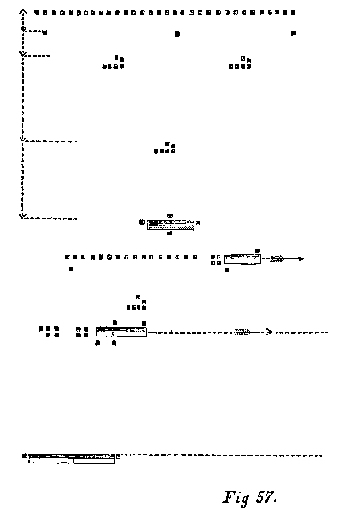
(Fig.
57.) At the first command, the first and third lieutenants will place themselves,
respectively, two paces behind the centres of the first and second sections
of the second platoon; the fifth sergeant will place himself one pace in
front of the centre of the second platoon; the third sergeant, as soon
as he can pass, will place himself on the right of the front rank of the
same platoon. The captain will indicate to him the point on which
he wishes him to direct his march. The chief of the first platoon
will execute what has been prescribed for the chief of the second platoon,
No. 264. The fourth sergeant will place himself on the left flank
of the reserve, the first sergeant will remain on the right flank.
At
the second command, the first and third lieutenants will place themselves
two paces behind the left group of their respective sections.
At
the command march, the second platoon will face to
the right and commence the movement; the left group of fours will stand
fast, but will deploy as soon as there is room on its right, conforming
to what has been prescribed, No. 264; the third sergeant will place himself
on the left of the right group, to conduct it; the second group will halt
at twenty paces from the one on its left, the third group at twenty paces
from the second, and so on to the right. As the groups halt, they
will face to the enemy, and deploy as has been explained for the left group.
The
chiefs of sections will pay particular attention to the successive deployments
of the groups, keeping near the group about to halt, so as to rectify any
errors which may be committed. When the deployment is completed,
they will place themselves thirty paces in rear of the centre of their
sections, as has been heretofore prescribed. The non-commissioned
officers will also place themselves as previously indicated.
As
soon as the movement commences, the chief of the first platoon, causing
it to face about, will move it as indicated No. 264.
The
deployment may be made by the left flank according to the same principles,
substituting left flank for right flank.
266.
If the captain should wish to deploy the company upon the centre of one
of the platoons, be will command:
1. Second platoon - as skirmishers. 2. By the right and left flanks - take intervals. 3. MARCH (or double quick - MARCH).
At
the first command, the officers and non-commissioned officers will conform
to what has been prescribed No. 265.
At
the second command, the first lieutenant will place himself behind the
left group of the right section of the second platoon, the third lieutenant
behind the right group of the left section the same platoon.
At
the command march, the right section will face to
the right, the left section will face to the left, the group on the right
of this latter section will stand fast. The two sections will move
off in opposite directions; the third sergeant will place himself on the
left of the right file to conduct it, the second sergeant on the right
the left file. The two groups nearest that which stands fast, will
each halt at twenty paces from this group, and each of the other groups
will halt at twenty paces from the group which is in rear of it.
Each group will deploy as heretofore prescribed No. 264.
The
first and third lieutenants will direct the movement, holding themselves
always abreast of the group which is about to halt.
The
captain can cause the deployment to be made on any named group whatsoever;
in this case the fifth sergeant will place himself before the group indicated,
and the deployment will be made according to the principles heretofore
prescribed.
The
entire company may be also deployed, according to the same principles.
To extend intervals.
267.
This movement, which is employed to extend a line of skirmishers, will
be executed according to the principles prescribed for deployments.
If
it be supposed that the line of skirmishers is at a halt, and that the
captain wishes to extend it to the left, he will command:
1. By the left flank (so many paces) extend intervals. 2. MARCH (or double quick - MARCH).
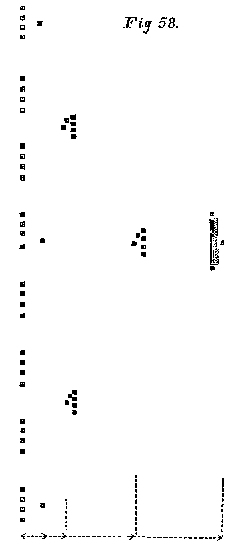
(Fig. 58.) At the command march, the
group on the right will stand fast, all the other groups will face to the
left, and each group will extend its interval to the prescribed distance
by the means indicated No. 265.
The
men of the same group will continue to preserve between each other the
distance of five paces, unless the nature of the ground should render it
necessary that they should close nearer, in order to keep in sight of each
other. The intervals refer to the spaces between the groups, and
not to the distances between the men in each group. The intervals
will be taken from the right or left man of the neighboring group.
If
the line of skirmishers be marching to the front, and the captain should
wish to extend it to the right, he will command:
1. On the left group (so many paces) extend intervals. 2. MARCH (or double quick - MARCH).
The
left group, conducted by the guide, will continue to march on the point
of direction; the other groups throwing forward the left shoulder, and
taking the double quick step, will open their intervals to the prescribed
distance.
Intervals
may be extended on the centre of this line, according to the same principles.
If,
in extending intervals, it be intended that one company or platoon should
occupy a line which had been previously occupied by two, the men of the
company or platoon which is to retire, will fall successively to the rear
as they are relieved by the extension of the intervals.
To close intervals.
268.
This movement, like that of opening intervals, will be executed according
to the principles prescribed for the deployments.
If
the line of skirmishers be halted, and the captain should wish to close
intervals to the left, he will command:
1. By the left flank (so many paces) close intervals. 2. MARCH ( or double quick - MARCH).
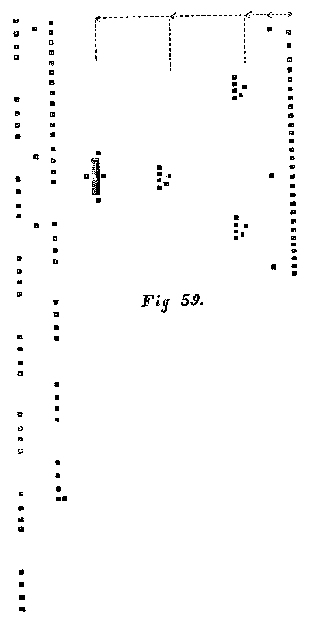
(Fig.
59.) At the command march, the left group will stand
fast, the other groups will face to the left and close to the prescribed
distance, each group facing to the enemy as it attains its proper distance.
If
the line be marching to the front, the captain will command:
1. On the left group (so many paces) close intervals. 2. MARCH (or double quick - MARCH).
The
left group, conducted by the guide, will continue to move on in the direction
previously indicated; the other groups, advancing the right shoulder, will
close to the left, until the intervals are reduced to the prescribed distance.
Intervals
may be closed on the right, or on the centre, according to the same principles.
When
intervals are to be closed up, in order to reinforce a line of skirmishers,
so as to cause two companies to cover the ground which had been previously
occupied by one, the new company will deploy so as to finish its movement
at twenty paces in rear of the line it is to occupy, and the men will successively
move upon that line, as they shall be unmasked by the men of the old company.
The reserves of the two companies will unite behind the centre of the line.
To relieve a company deployed as skirmishers.
269.
When a company of skirmishers is to be relieved, the captain will be advised
of the intention, which he will immediately communicate to the first and
second lieutenants.
The
new company will execute its deployment forward, so as to finish the movement
at about twenty paces in rear of the line.
Arrived
at this distance, the men of the new company, by command of their captain,
will advance rapidly a few paces beyond the old line and halt; the new
line being established, the old company will assemble on its reserve, taking
care not to get into groups of fours until they are beyond the fire of
the enemy.
If
the skirmishers to be relieved are marching in retreat, the company thrown
out to relieve them will deploy by the flank, as prescribed No. 265 and
following. The old skirmishers will continue to retire with order,
and having passed the new line, they will form upon the reserve.
To advance.
To advance in line, and to retreat in line.
270.
When a platoon or a company deployed as skirmishers is marching by the
front, the guide will be habitually in the centre. No particular
indication to this effect need be given in the commands, but if on the
contrary it be intended that the directing guide should be on the right,
or left, the command guide right, or guide left,
will be given immediately after that of forward.
The
captain, wishing the line of skirmishers to advance, will command:
1. Forward. 2. MARCH (or double quick - MARCH).
This
command will be repeated with the greatest rapidity by the chiefs of sections,
and in case of need, by the sergeants. This rule is general,
whether the skirmishers march by the front or by the flank.
At
the first command, three sergeants will move briskly on the line, the first
on the right, the second on the left, and the third in the centre.
At
the command march, the line will move to the front, the guide charged with
the direction will move on the point indicated to him, the skirmishers
will hold themselves aligned on this guide, and preserve their intervals
towards him.
The
chiefs of sections will march immediately behind their sections, so as
to direct their movements.
The
captain will give a general superintendence to the movement.
When
he shall wish to halt the skirmishers, he will command:
HALT.
At
this command, briskly repeated, the line will halt. The chiefs of
sections will promptly rectify any irregularity in the alignment and intervals,
and after taking every possible advantage which the ground may offer for
protecting the men, they, with the three sergeants in the line, will retire
to their proper places in rear.
271.
The captain, wishing to march the skirmishers in retreat, will command:
1. In retreat. 2. MARCH (or double quick - MARCH).
At
the first command, the three sergeants will move on the line as prescribed
No. 270.
At
the command march, the skirmishers will face about
individually, and march to the rear, conforming to the principles prescribed
No. 270.
The
officers and sergeants will use every exertion to preserve order.
To
halt the skirmishers, marching in retreat, the captain will command:
HALT.
At
this command, the skirmishers will halt, and immediately face to the front.
The
chiefs of sections and the three guides will each conform himself to what
is prescribed No. 270.
To change direction.
272. If the commander of a line of skirmishers shall wish to cause it to change direction to the right, he will command:
1. Right wheel. 2. MARCH (or double quick - MARCH).
At
the command march, the right guide will mark time
in his place; the left guide will move in a circle to the right, and that
he may properly regulate his movements, will occasionally cast his eyes
to the right, so as to observe the direction of the line, and the nature
of the ground to be passed over. The centre guide will also march
in a circle to the right, and in order to conform his movements to the
general direction, will take care that his steps are only half the length
of the steps of the guide on the left.
The
skirmishers will regulate the length of their steps by their distance from
the marching flank, being less as they approach the pivot, and greater
as they are removed from it; they will often look to the marching flank,
so as to preserve the direction and their intervals.
When
the commander of the line shall wish to resume the direct march, he will
command:
1. Forward. 2. MARCH.
At
the command march, the line will cease to wheel, and
the skirmishers will move direct to the front; the centre guide will march
on the point which will be indicated to him.
If
the captain should wish to halt the line, in place of moving it to the
front, he will command:
HALT.
At
this command, the line will halt.
A
change of direction to the left will be made according to the same principles,
and by inverse means.
A
line of skirmishers marching in retreat will change direction by the same
means, and by the same commands, as a line marching in advance; for example,
if the captain should wish to refuse his left, now become the right, he
will command:
1. Left wheel. 2. MARCH.
At
the command halt, the skirmishers will face to the
enemy.
But
if; instead of halting the line, the captain should wish to continue to
march it in retreat, he will, when he judges the line has wheeled sufficiently,
command:
1. In retreat. 2. MARCH.
To march by the flank.
273. The captain, wishing the skirmishers to march by the right flank, will command:
1. By the right flank. 2. MARCH (or double quick - MARCH).
At
the first command, the three sergeants will place themselves on the line.
At
the command march, the skirmishers will face to the
right and move off; the right guide will place himself by the side of the
leading man on the right to conduct him, and will march on the point indicated;
each skirmisher will take care to follow exactly in the direction of the
one immediately preceding him, and to preserve his distance.
The
skirmishers may be marched by the left flank, according to the same principles,
and by the same commands, substituting left for right;
the left guide will place himself by the side of the leading man to conduct
him.
If
the skirmishers be marching by the flank, and the captain should wish to
halt them, he will command:
HALT.
At
this command, the skirmishers will halt and face to the enemy. The
officers and sergeants will conform to what has been prescribed No. 270.
The
reserve should execute all the movements of the line, and be held always
about 150 paces from it, so as to be in position to second its operations.
When
the chief of the reserve shall wish to march it in advance, he will command:
1. Platoon forward. 2. Guide left. 3. MARCH.
If he should wish to march it in retreat, he will command:
1. In retreat. 2. MARCH. 3. Guide right.
At
the command halt, it will re-face to the enemy.
The
men should be made to understand that the signals or commands, such as
forward, mean that the skirmishers shall march on
the enemy; in retreat, that they shall retire, and
to the right or left flank, that the men must face
to the right or left, whatever may be their position.
If
the skirmishers be marching by the flank, and the captain should wish to
change direction to the right (or left), he will command:
1. By file right (or left). 2. MARCH.
These movements will also be executed by the signals No. 262.
THE FIRINGS.
274. Skirmishers will fire either at a halt or marching.
To fire at a halt.
To cause this fire to be executed, the captain will command:
Commence - FIRING.
At this command, briskly repeated, the men of the front rank will commence
firing; they will reload rapidly, and hold themselves
in readiness to fire again. During this time the men of the rear
rank will come to a ready, and as soon as their respective file leaders
have loaded, they will also fire and reload. The men of each file
will thus continue the firing, conforming to this principle, that the one
or the other shall always have his piece loaded.
Light
troops should be always calm, so as to aim with accuracy; they should,
moreover, endeavor to estimate correctly the distances between themselves
and the enemy to be hit, and thus be enabled to deliver their fire
with the greater certainty of success.
Skirmishers
will not remain in the same place whilst reloading, unless protected by
accidents in the ground.
To fire marching.
275.
This fire will be executed by the same commands as the fire at a halt.
At
the command commence firing, if the line be advancing,
the front rank man of every file will halt, fire, and reload before throwing
himself forward. The rear rank man of the same file will continue
to march, and after passing ten or twelve paces beyond his front rank man
will halt, come to a ready, select his object, and fire then his front
rank man has loaded; the fire will thus continue to be executed by each
file; the skirmishers will keep united, and endeavor, as much as possible,
to preserve the general direction of the alignment.
If
the line be marching in retreat at the command commence firing,
the front rank man of every file will halt, face to the enemy, fire, and
then reload whilst moving to the rear; the rear rank man of the same file
will continue to march, and halt ten or twelve paces beyond his front rank
man, face about, come to a ready, and fire, when his front rank man has
passed him in retreat and loaded; after which, he will move to the rear
and reload; the front rank man in his turn after marching briskly to the
rear, will halt at ten or twelve paces from the rear rank, face to the
enemy; load his piece and fire, conforming to what has just been prescribed;
the firing will thus be continued.
If
the company be marching by the right flank, at the command, commence
firing, the front rank man of every file will face to the enemy,
step one pace forward, halt, and fire; the rear rank man will continue
to move forward. As soon as the front rank man has fired, he will
place himself briskly behind his rear rank man and reload whilst marching.
When he has loaded, the rear rank man will in his turn, step one pace forward,
halt, and fire, and returning to the ranks, will place himself behind his
front rank man; the latter, in his turn, will act in the same manner, observing
the same principles. At the command, cease firing,
the men of the rear rank will retake their original positions, if not already
there.
If
the company be marching by the left flank, the fire will be executed according
to the same principles, but in this case it will be the rear rank men who
will be first.
The
following rules will be observed in the cases to which they apply:
If
the line be firing at a halt, or whilst marching by the flank at the command,
Forward - MARCH, it will be the men whose pieces are
loaded, without regard to the particular rank to which they belong, who
will move to the front. Those men whose pieces have been discharged,
will remain in their places to load them before moving forward, and the
firing will be continued agreeably to the principles prescribed above.
If
the line be firing either at a halt, advancing, or whilst marching by the
flank, at the command, In retreat - MARCH, the men
whose pieces are loaded will remain faced to the enemy, and will fire in
this position; the men whose pieces are discharged will retreat loading
them, and the fire will be continued agreeably to principles prescribed
for the fire in marching in retreat.
If
the line of skirmishers be firing either at a halt, advancing, or in retreat,
at the command, By the right (or left) flank -
MARCH, the men whose pieces are loaded will step one pace out
of the general alignment, face to the enemy, and fire in this position;
the men whose pieces are unloaded will face to the right (or left) and
march in the direction indicated. The men who stepped out of the
ranks will place themselves, immediately after firing, upon the general
direction, and in rear of their front or rear rank men, as the case may
be. The fire will be continued according to the principles prescribed
for firing when marching by a flank.
Skirmishers
will be habituated to load their pieces whilst marching; but they will
be enjoined to halt always an instant, when in the act of charging cartridge,
and priming.
They
should be practised to fire and load kneeling, lying down, and sitting,
and much liberty should be allowed in these exercises, in order that they
may be executed in the manner found to he most convenient. Skirmishers
should he cautioned not to forget that, in whatever position they may load,
it is important that the piece should be placed upright before ramming,
in order that the entire charge of powder may reach the bottom of the bore.
In
commencing the fire, the men of the same rank should not all fire at once,
and the men of the same file should be particular that one or the other
of them be always loaded.
In
retreating, the officer commanding the skirmishers should seize on every
advantage which the ground may present, for arresting the enemy as long
as possible.
At
the signal to cease firing, the captain will see that
the order is promptly obeyed; but the men who may not be loaded, will load.
If the line be marching, it will continue the movement; but the man of
each file who happens to be in front, will wait until the man in rear shall
be abreast with him.
If
a line of skirmishers be firing advancing, at the command halt,
the line will re-form upon the skirmishers who are in front; when the line
is retreating, upon the skirmishers who are in rear.
276.
Officers should watch with the greatest possible vigilance over a line
of skirmishers; in battle, they should neither carry a rifle or fowling
piece. In all the firings, they, as well as the sergeants, should
see that order and silence are preserved, and that the skirmishers do not
wander imprudently; they should especially caution them to be calm and
collected; not to fire until they distinctly perceive the objects at which
they aim, and are sure that those objects are within proper range.
Skirmishers should take advantage promptly, and with intelligence, of all
shelter, and of a accidents of the ground, to conceal themselves from the
view of the enemy, and to protect themselves from his fire. It may
often happen that intervals are momentarily lost when several men near
each other find a common shelter; but when they quit this position, they
should immediately resume their intervals and their places in line, so
that they may not, by crowding, needlessly expose themselves the fire of
the enemy.
THE RALLY.
To form column.
277.
A company deployed as skirmishers, is rallied in order oppose the enemy
with better success; the rallies are made at a run, and with bayonets fixed;
when ordered to rally, the skirmishers fix bayonets without command.
There
are several ways of rallying, which the chief of the line will adopt according
to circumstances.
If
the line, marching or at a halt, be merely disturbed by scattered horsemen,
it will not be necessary to fall back on the reserve, but the captain will
cause bayonets to be fixed. If the horsemen should, however, advance
to charge the skirmishers, the captain will command, rally by fours.
The line will halt if marching, and the four men of each group will execute
this rally in the following manner: the front rank man of the even numbered
file will take the position of guard against cavalry;
the rear rank man of the odd numbered file will also take the position
of guard against cavalry, turning his back to him, his right
foot thirteen inches from the right foot of the former, and parallel to
it; the front rank man of the odd file, and the rear rank man of the even
file, will also place themselves back to back, taking a like position,
and between the two men already established, facing to the right and left;
the right feet of the four men will be brought together, forming a squares
and serving for mutual support. The four men in each group will come
to a ready, fire as occasion may offer, and load without moving their feet.
(Fig. 60.)

The
captain and chiefs of sections will each cause the four men who constitute
his guard to form square, the men separating so as to enable him and the
bugler to place themselves in the centre. The three sergeants will
each promptly place himself in the group nearest him in the line of skirmishers.
Whenever
the captain shall judge these squares too weak, but should wish to hold
his position by strengthening his line, he will command:
Rally by sections.
278. At this command, the chiefs of sections will move rapidly on the centre group of their respective sections, or on any other interior group whose position might offer a shelter, or other particular advantage; the skirmishers will collect rapidly at a run on this group, and without distinction of numbers. The men composing the group on which the formation is made, will immediately form square, as heretofore explained, and elevate their pieces, the bayonets uppermost, in order to indicate the point on which the rally is to be made. The other skirmishers, as they arrive, will occupy and fill the open angular spaces between these four men, and successively rally around this first nucleus, and in such manner as to form rapidly a company circle. The skirmishers will take as they arrive, the position of charge bayonet, the point of the bayonet more elevated, and will cock their pieces in this position. The movement concluded, the two exterior ranks will fire as occasion may offer, and load without moving the feet. (Fig. 61.)

The
captain will move rapidly with his guard, wherever he may judge his presence
most necessary.
The
officers and sergeants will be particular to observe that the rally is
made in silence, and with promptitude and order; that some pieces in each
of their subdivisions be at all times loaded, and that the fire is directed
on those points only where it will be most effective.
If
the reserve should be threatened, it will form into a circle around its
chief.
If
the captain, or commander of a line of skirmishers formed of many platoons,
should judge that the rally by section does not offer sufficient resistance,
he will cause the rally by platoons to be executed, and for this purpose,
will command:
Rally by platoons.
279.
This movement will be executed according to the same principles, and by
the same means, as the rally by sections. The chiefs of platoon will
conform to what has been prescribed for the chiefs of section.
The
captain wishing to rally the skirmishers on the reserve, will command:
Rally on the reserve.
280.
At this command, the captain will move briskly on the reserve; the officer
who commands it will take immediate steps to form square; for this purpose,
he will cause the half sections on the flanks to be thrown perpendicularly
to the rear; he will order the men to come to a ready.
The
skirmishers of each section, taking the run, will form rapidly into groups,
and upon that man of each group who is nearest the centre of the section.
These groups will direct themselves diagonally towards each other, and
in such manner as to form into sections with the greatest possible rapidity
while moving to the rear; the officers and sergeants will see that this
formation is made in proper order, and the chiefs will direct their sections
upon the reserve, taking care to unmask it to the right and left.
As the skirmishers arrive, they will continue and complete the formation
of the square begun by the reserve, closing in rapidly upon the latter,
without regard to their places in line; they will come to a ready without
command, and fire upon the enemy; which will also be done by the reserve
as soon as it is unmasked by the skirmishers. (Fig. 62.)
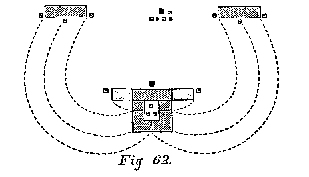
If
a section should be closely pressed by cavalry while retreating its chief
will command halt; at this command, the men will form rapidly
into a compact circle around the officer, who will re-form his section
and resume the march, the moment he can do so with safety.
The
formation of the square in a prompt and efficient manner, requires coolness
and activity on the part of both officers and sergeants.
The
captain will also profit by every moment of respite which the enemy's cavalry
may leave him; as soon as he can, he will endeavor to place himself beyond
the reach of their charges, either by gaining a position where he may defend
himself with advantage, or by returning to the corps to which he belongs.
For this purpose, being in square, he will cause the company to break into
column by platoons at half distance; to this effect, he will command:
1. Form column. 2. MARCH.
At
the command march, each platoon will dress on its centre,
and the platoon which was facing to the rear will face about without command.
The guides will place themselves on the right and left of their respective
platoons, those of the second platoon will place themselves at half distance
from those of the first, counting from the rear rank. These dispositions
being made, the captain can move the column in whatever direction he may
judge proper.
If
he wishes to march it in retreat, he will command:
l. In retreat. 2. MARCH (or double quick - MARCH).
At the command march, the column will immediately face by the rear rank, and move off in the opposite direction. As soon as the column is in motion, the captain will command:
3. Guide right (or left).
He
will indicate the direction to the leading guide; the guides will march
at their proper distances, and the men will keep aligned.
If
again threatened by cavalry, the captain will command:
1. Form square. 2. MARCH
At
the command march, the column will halt; the first
platoon will face about briskly, and the outer half sections of each platoon
will be thrown perpendicularly to the rear, so as to form the second and
third fronts of the square. The officers and sergeants will promptly
rectify any irregularities which may be committed.
If
he should wish to march the column in advance, the captain will command:
1. Form column. 2. MARCH.
Which
will be executed as prescribed above.
The
column being formed, the captain will command:
1. Forward. 2. MARCH (or double quick - MARCH). 3. Guide left (or right).
At
the second command, the column will move forward, and at the third command,
the men will take the touch of elbows to the side of the guide.
If
the captain should wish the column to gain ground to the right or left,
he will do so by rapid wheels to the side opposite the guide, and for this
purpose, will change the guide whenever it may be necessary.
281.
If a company be in column by platoon, at half distance, right in front,
the captain can deploy the first platoon as skirmishers by the means already
explained; but if it should be his wish to deploy the second platoon forward
on the centre file, leaving the first platoon in reserve, he will command:
1. Second platoon - as skirmishers. 2. On the centre file take intervals. 3. MARCH (or double quick - MARCH.)
At
the first command, the chief of the first platoon will caution his platoon
to stand fast; the chiefs of sections of the second platoon will place
themselves before the centre of their sections; the fifth sergeant will
place himself one pace in front of the centre of the second platoon.
At
the second command, the chief of the right section, second platoon, will
command: Section right face; the chief of the left
section: Section left face.
At
the command march, these sections will move off briskly
in opposite directions, and having unmasked the first platoon, the chiefs
of sections will respectively command: By the left flank - MARCH,
and By the right flank - MARCH; and as soon as these
sections arrive on the alignment of the first platoon, they will command:
As skirmishers - MARCH. The groups will then deploy
according to prescribed principles, on the right group of the left section,
which will be directed by the fifth sergeant on the point indicated.
If
the captain should wish the deployment made by the flank, the second platoon
will be moved to the front by the means above stated, and halted after
passing some steps beyond the alignment of the first platoon; the deployment
will then be made by the flank according to the principles prescribed.
When
one or more platoons are deployed as skirmishers, and the captain should
wish to rally them on the battalion, he will command:
Rally on the battalion.
282.
At this command, the skirmishers and the reserve, no matter what position
the company to which they belong may occupy in order of battle, will rapidly
unmask the front of the battalion, directing themselves in a run towards
its nearest flank, and then form in its rear.
As
soon as the skirmishers have passed beyond the line of file-closers, the
men will take the quick step, and the chief of each platoon or section
will re-form his subdivision, and place it in column behind the wing on
which it is rallied, and at ten paces from the rank of file-closers.
These subdivisions will not be moved except by order of the commander of
the battalion, who may, if he thinks proper, throw them into line of battle
at the extremities of the line, or in the intervals between the battalions.
If
many platoons should be united behind the same wing of s battalion, or
behind any shelter whatsoever, they should be formed always into close
column, or into column at half distance.
When
the battalion, covered by a company of skirmishers, shall be formed into
square, the platoons and sections of the covering company will be directed
by their chiefs to the rear of the square which will be opened at the angles
to receive the skirmishers, who will be then formed into close column by
platoons in rear of the first front of the square.
If
circumstances should prevent the angles of the square from being opened,
the skirmishers will throw themselves at the feet of the front rank men,
the right knee on the ground, the butt of the piece resting on the thigh,
the bayonet in a threatening position. A part may also place themselves
about the angles, where they render good service by defending the sectors
without fire.
If
the battalion on which the skirmishers are rallied be in column ready to
form square, the skirmishers will be formed into close column by platoon,
in rear of the centre of the third division, and at the command, Form
square - MARCH, they will move forward and close on the buglers.
When
skirmishers have been rallied by platoon or section behind the wings of
a battalion, and it be wished to deploy them again to the front, they will
be marched by the flank towards the intervals on the wings, and be then
deployed so as to cover the front of the battalion.
When
platoons or sections, placed in the interior of squares or columns, are
to be deployed, they will be marched out by the flank and then thrown forward,
as is prescribed, No. 281; as soon as shall have unmasked the column or
square, they will be deployed, the one on the right, the other on the left
file.
The assembly.
283.
A company deployed as skirmishers will be assembled when there is no longer
danger of its being disturbed; the assembly will be made habitually in
quick time.
The
captain wishing to assemble the skirmishers on the reserve, will command:
Assemble on the reserve.
At
this command, the skirmishers will assemble by groups of fours; the front
rank men will place themselves behind their rear rank men; and each group
of fours will direct itself on the reserve, where each will take its proper
place in the ranks. When the company is re-formed, it will rejoin
the battalion to which it belongs.
It
may be also proper to assemble the skirmishers on the center, or on the
right or left of the line, either marching or at a halt.
If
the captain should wish to assemble them on the centre while marching,
he will command:
Assemble on the centre.
At
this command, the centre guide will continue to march directly to the front
on the point indicated; the front rank man of the directing file will follow
the guide, and be covered by his rear rank man; the other two comrades
of this group, and likewise those on their left will march diagonally,
advancing the left shoulder and accelerating the gait, so as to re-form
the groups while drawing nearer and nearer the directing file; the men
of the right section will unite in the same manner into groups, and then
upon the directing file, throwing forward the right shoulder. As
they successively unite on the centre, the men will bring their pieces
to the right shoulder.
To
assemble on the right or left file will be executed according to the same
principles.
The
assembly of a line marching in retreat will also be executed according
to the same principles, the front rank men marching behind their rear rank
men.
To
assemble the line of skirmishers at a halt, and on the line they occupy,
the captain will give the same commands; the skirmishers will face to the
right or left, according as they should march by the right or left flank,
re-form the groups while marching, and to arrive on the file which served
as the point of formation. As they successively arrive, the skirmishers
will support arms.
ARTICLE III. CONTENTS. ARTICLE V.